From a village shop to artisan perfumery
In 1942 Giovan Piero and Emma Ducci opened a small shop in Bibbiena that, thanks to his experience at the village pharmacy, came to specialize in fragrances and ointments. In the 1960s their daughter Irma turned it into a perfumery. Today the story continues with Silvia Martinelli, co-founder and nose of the house, who grew up in the family perfumery and leads research and development within the company. The house describes a short, Italian supply chain: the blend of ingredients is assembled in Italy, maceration and bottling take place in two Tuscan workshops, and the caps are made of FSC-certified wood. It uses no raw materials of animal origin, and any animalic notes are entirely synthetic.
The perfumes by olfactory family
Sweet and gourmand
The house describes Bianco Latte as a cloud of vanilla, milk and honey, an amber fragrance with a contemporary soul. Borabora pairs flowers such as tiaré, ylang ylang and jasmine with coconut and vanilla, over musks and amber notes. Then there is Oro e Miele, centered on wildflower honey and opening with almond blossom, rose and heliotrope.
Fresh, clean, aromatic
Among the fresh scents is Celeste, with a softly citrus opening, a floral touch of iris and violet and a base of vanillin and ambroxan. Colonia Nobile is a musky citrus that reinterprets the Italian cologne, with bergamot, petitgrain and neroli up top, jasmine at the heart and oakmoss in the base. For a marine accord there is Blu Mare, which combines citrus, pink pepper and cypress. Verde Respiro is an aromatic green with bergamot, blackberry, clary sage and lavender, while Ricordami opens with citrus, galbanum and fig leaf and has magnolia and lily of the valley at its heart.
Floral
Almafolia is the tuberose perfume, accompanied by jasmine, ylang ylang and coconut over a vanilla base. From the same family comes Scintilla, which opens with fruity notes and has a heart of iris, violet and jasmine, wrapped in patchouli and woods. Finally, Shabby Chic pairs Virginia cedar with a lightly honeyed Bulgarian rose and Javanol, a sandalwood note.
Amber, spicy, woody
Among the ambers is Bianco Oro, built on Cetalox, an amber note, with black pepper and patchouli. Christos is a resinous scent, where cistus, pepper, vanilla and rose give way to incense. Rosso Rubino combines rose, berries and cocoa with patchouli and coumarin, playing sweet against balsamic, vanilla against spice. There is also Rosso Radice, which starts with Calabrian bergamot and moves on to vetiver, oakmoss and coumarin, and Blu Indaco, which the house calls the perfume of contrast, pairing Calabrian bergamot, sweet and bitter almond and vanilla with a heart of frangipani.
How to choose a Giardini di Toscana perfume
If you love vanilla notes, look at Bianco Latte, Borabora and Celeste, which the house names as its most gourmand fragrances. For a clean scent there are Celeste and Colonia Nobile, while tuberose lovers will find Almafolia. Bianco Oro, Christos and Rosso Rubino are the choices for an amber, resinous or spicy perfume. If you prefer green, there are Verde Respiro and Ricordami, and for a marine accord there is Blu Mare.
The house feels that some fragrances suit summer and others winter better, without any real seasonality. To help you decide, you can start with the sample kit, which gathers 2 ml spray vials of every eau de parfum in the line, at a concentration above 25%.
Layering, body creams and travel size
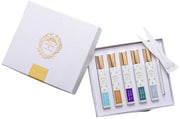
On the perfume pages, the house also suggests how to layer them. Bianco Latte can be paired with Rosso Radice, which adds a green, woody note to the sweetness of honey and caramel, or with Borabora, which adds tiaré and ylang ylang. Colonia Nobile pairs with Almafolia, since both have jasmine at the heart, so the tuberose meets the citrus. To try the combinations there is the Layering Kit, with five 8 ml eau de parfums, including Bianco Latte, Bianco Oro and Blu Indaco.
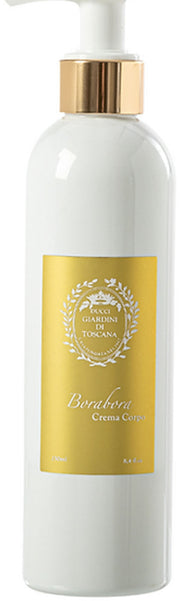
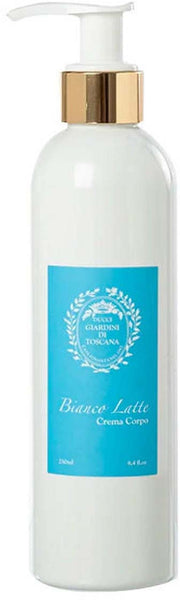
Some fragrances also come as a body cream. The Bianco Latte body cream is suitable for every skin type and leaves skin hydrated and velvety. The Borabora cream is also for all skin types, and according to the house it can be applied before spraying the perfume to boost its intensity. The Blu Indaco cream has a clean scent and is formulated with Hydropuntil, hyaluronic acid, PENTAVITIN®, vitamin E and olive unsaponifiables. Finally, to carry your eau de parfum with you, there is the 5 ml refillable spray bottle.
Frequently asked questions
Where is Giardini di Toscana from?
It is an Italian brand from Bibbiena, a village in the Casentino area in the province of Arezzo, where it has its registered office and boutique. The house traces its history to the fragrance and ointment shop opened there in 1942 by Giovan Piero and Emma Ducci, which their daughter Irma later turned into a perfumery.
Who makes Giardini di Toscana perfumes?
The perfumes are created by Silvia Martinelli, co-founder and nose of the house, who oversees research and development within the company. The blend is then assembled in Italy by a partner, while maceration and bottling take place in Tuscany, in two family-run workshops.
What does Bianco Latte smell like?
Bianco Latte is an amber gourmand eau de parfum that opens on caramel, has a heart of honey and coumarin and a base of vanilla and white musks. The house describes it as a creamy, enveloping fragrance to wear all year round, and the same scent also comes as a body cream.
What is the difference between Bianco Latte and Bianco Oro?
Bianco Latte and Bianco Oro share part of their name, but not their composition. Bianco Latte is a gourmand amber built on vanilla, milk and honey, while Bianco Oro is a spicy amber centered on Cetalox, an amber note, accompanied by black pepper and patchouli.
Are Giardini di Toscana perfumes unisex?
Yes, the house considers all its fragrances unisex and calls the split between men's and women's scents a mere commercial formula. Alongside vanilla fragrances such as Bianco Latte, Borabora and Celeste, it offers woody, resinous or spicy ones, such as Christos, Rosso Radice and Bianco Oro.
Which perfume to choose if you like fresh, clean notes?
If you love fresh, clean notes, you can choose between Celeste and Colonia Nobile. Celeste combines soft citrus, iris and violet with a base of vanillin and ambroxan, while Colonia Nobile is a reimagined Italian cologne, a musky citrus with bergamot, petitgrain and neroli. For a marine accord there is Blu Mare, with citrus, pink pepper and cypress.
Which perfume for white flower lovers?
For white flowers the go-to is Almafolia, built on tuberose with jasmine, white rose and ylang ylang over a vanilla base. Borabora also features jasmine and ylang ylang, but pairs them with tiaré, coconut and vanilla.
Which perfumes can be layered together?
The pairings suggested by the house often start from Bianco Latte, which can be layered with Rosso Radice for a green, woody note or with Borabora to add tiaré and ylang ylang. Colonia Nobile pairs with Almafolia, linked by jasmine. The Layering Kit gathers five 8 ml eau de parfums so you can try the combinations.
How can I try all the perfumes before choosing?
To try them all there is the sample kit, with a 2 ml spray vial of each eau de parfum in the line, from Almafolia, Bianco Latte, Bianco Oro and Blu Indaco to Blu Mare, Borabora, Celeste, Christos, Colonia Nobile, Oro e Miele and Ricordami. The house states a concentration above 25% for the vials.
Do the perfumes contain animal-derived ingredients?
No, the house states that it uses no raw materials extracted from animals, and any animalic notes are entirely synthetic. It also excludes plants whose cultivation harms the natural balance and does not export to countries that require animal testing.